
5 Must-Haves for Modern Day School Playgrounds
Posted by May Recreation Content Team on
School playgrounds have changed significantly over the years. While swings, slides, climbers, and monkey bars remain playground favorites, today's schools are looking for outdoor spaces that accomplish much more than simply giving students somewhere to play during recess.
A thoughtfully designed school playground can encourage physical activity, support social-emotional development, accommodate students with varying abilities, provide sensory experiences, and even become an extension of the learning environment.
That matters when you consider how much time today's children spend being sedentary. According to the CDC, children and adolescents ages 6–17 should get 60 minutes or more of moderate-to-vigorous physical activity every day.
Recess can help children meet the physical activity time. The CDC reports that recess can increase students' physical activity while also benefiting memory, attention, concentration, classroom behavior, and social-emotional development.
So, what belongs on a present-day school playground? Here are five features schools should consider when planning their next outdoor play space.
1. Inclusive and Accessible Play Opportunities
Accessibility should no longer be viewed as an optional playground feature. It should be considered from the beginning of the design process.
Present-day playgrounds should give children with different physical, sensory, and developmental abilities meaningful opportunities to participate. That goes beyond simply providing a route onto the playground. Schools should consider how children move throughout the space, which activities they can reach, and whether they can play alongside their classmates.
Inclusive design can incorporate accessible routes and surfacing, ground-level activities, transfer points, sensory components, musical elements, social spaces, and play experiences that appeal to different abilities and comfort levels.
Instead of creating separate spaces for different children, the goal is to develop environments where more students can participate together.
This can make recess more welcoming while encouraging interaction among students who might not otherwise play together.
2. Equipment That Keeps Kids Moving
A school playground should make physical activity exciting.
Traditional components such as slides and swings still have their place, but schools can provide a wider range of movement experiences through climbing systems, balance activities, overhead climbers, obstacle-style challenges, and other equipment that encourages children to use their entire bodies.
Climbing, for example, can challenge grip and upper-body strength while requiring coordination and problem-solving. Balance components can test agility and coordination, while obstacle-style elements give children opportunities to climb, navigate, race, and create their own challenges.
Some school playground recommendations include overhead climbing systems, balance and coordination activities, and obstacle courses because these features can support strength, mobility, coordination, agility, and endurance.
Modern playgrounds can take that concept even further by providing different levels of physical challenge. One student may want to race across an obstacle course, while another may prefer navigating a balance element at their own pace.
Providing variety helps encourage more children to find a form of movement they enjoy.
3. Sensory Play and Spaces to Recharge
Not every child experiences the playground in the same way.
For some students, a busy playground filled with movement, noise, and activity is exciting. For others, the same environment can become overwhelming. That's why present-day school playgrounds should include both sensory-rich activities and opportunities for quieter play.
Sensory components might incorporate different textures, sounds, movement, colors, tactile panels, or hands-on activities. These features can encourage exploration and give students different ways to interact with their environment.
At the same time, schools can incorporate quieter areas where students can step away from highly active play.
Another recommendation is quiet or recovery spaces for children who need a place to rest or decompress. That concept has become increasingly relevant as inclusive playground design has evolved.
A well-rounded playground doesn't have to keep every student moving at maximum speed. It should give children choices, whether they want to climb, socialize, explore a sensory activity, or simply find a calmer place to reset before returning to class.
4. Shade and Heat-Conscious Design
For schools in Texas and other warm climates, shade is more than an amenity. It can be an important part of creating a usable outdoor space.
Playground surfaces and equipment exposed to direct sunlight can become significantly hotter than surrounding air temperatures. Shaded play areas can be 20–30°F cooler than areas exposed to direct sunlight.
That's a meaningful difference when students are outside during the school day.
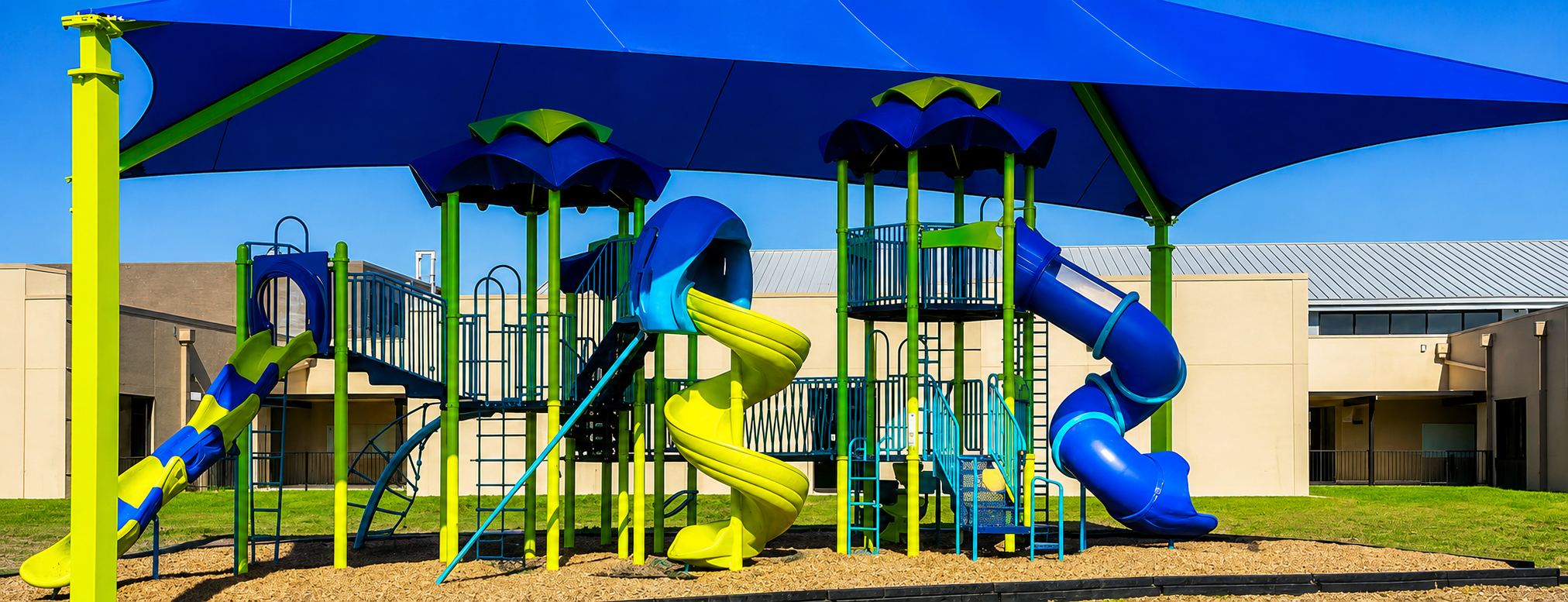
Schools can address thermal safety by incorporating integrated fabric canopies over play structures, freestanding shade structures, strategically planted trees, and shaded gathering or rest areas.
Equipment placement matters, too. May Recreation recommends considering the sun's daily path when orienting playground equipment and choosing lighter, more reflective colors when appropriate.
Shade can also help protect the school's investment. By reducing constant exposure to intense sunlight, shade structures can help protect playground equipment and create a more comfortable environment for students, teachers, and playground supervisors.
For a present-day school playground, especially in Texas, thinking about heat should happen during the design process, not after the playground has already been installed.
5. Safe, Accessible and Durable Surfacing
It's easy for brightly colored playground equipment to receive most of the attention during the design process, but what goes underneath that equipment is just as important.
Safety surfacing should be considered a core component of the playground itself.
Schools can explore options such as artificial turf and other safety surfacing solutions depending on their site, budget, accessibility requirements, maintenance needs, and playground design.
The right surfacing can help provide impact attenuation around play equipment while also creating accessible routes through the play area. For schools with hundreds of children potentially using the playground each week, durability and maintenance should also be major considerations.
May Recreation offers both artificial turf and playground safety surfacing, allowing schools to think about the complete recreation environment rather than treating the playground structure and surrounding surface as two separate projects.
Surfacing also presents an opportunity to improve the overall design. Different colors and patterns can establish play zones, pathways, gathering areas, or imaginative elements that make the ground itself part of the playground experience.
Designing a Playground for Today's Students
The present-day school playground is no longer just a collection of slides, swings, and climbers. It can be an intentionally designed environment that gives students opportunities to move, explore, socialize, recharge, and play together.
And those benefits can carry back into the classroom. According to the CDC, recess can help students improve memory, attention, and concentration, stay on task, reduce disruptive classroom behavior, and develop important social-emotional skills.
Creating that kind of environment requires looking at the entire space, from playground equipment and sensory activities to surfacing, shade, accessibility, and traffic flow.
May Recreation helps schools and communities develop complete outdoor recreation spaces with commercial playground systems, artificial turf, safety surfacing, shade structures, furnishings, sports equipment, and other recreation solutions. Their team can also help schools navigate the design and planning process to develop a playground around the needs of their students, site, and budget.
Planning a new school playground or updating an existing play space? Contact May Recreation to start designing a safer, more inclusive, engaging, and future-ready playground for your students.